
If you want to know how to price a cake, start with one fact: for a custom cake, your time usually costs more than your ingredients. A price that only doubles or triples the grocery bill leaves your hours unpaid. The reliable method is cost-plus: add up ingredients, your labor at an hourly rate, overhead and packaging, then add the profit you want and divide by servings to check the price per slice.
Below, that formula is worked through line by line for an 8-inch, two-layer vanilla cake with Swiss meringue buttercream, using US average retail prices published by the Bureau of Labor Statistics for September 2026. Swap in your own receipts and your own rate, and you have a price you can defend.
The cake pricing formula
Every line in the formula is a number you can look up or measure:
Price = (ingredients + labor + overhead + packaging) × (1 + profit margin)
- Ingredients: the share of each package you actually use, at what you paid for it.
- Labor: hours spent on the order (baking, cooling, filling, crumb coat, finishing, cleanup, customer messages) times your hourly rate.
- Overhead: the costs that do not show up in one recipe: oven electricity, gas, equipment wear, card fees, the share of your phone and website.
- Packaging: cake board, box and anything else that leaves with the cake.
- Profit margin: what the business earns on top of paying you for your time. It is a choice, not a cost.
Step 1: work out the ingredient cost
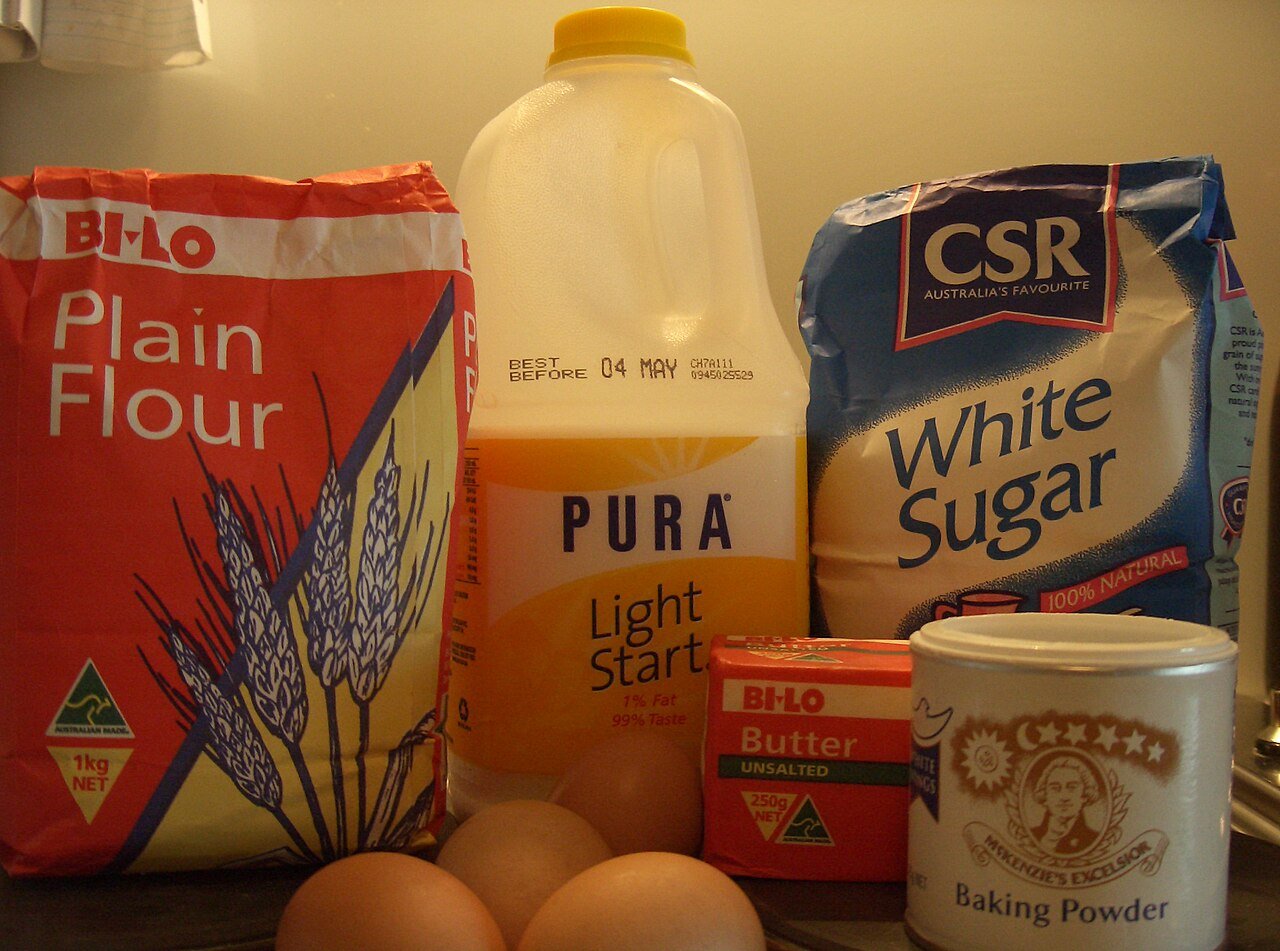
For each ingredient, divide the amount the recipe uses by the package size, then multiply by the package price. The prices below are US city averages for September 2026 from the BLS Average Price Data, which BLS collects for the Consumer Price Index (BLS average prices fact sheet). Your local store and your bulk suppliers will differ, so treat them as a reference, not as what you will pay.
| Ingredient | Amount used | BLS average price, Sep 2026 | Cost |
|---|---|---|---|
| Cake: two 8-inch layers | |||
| All-purpose flour | 2½ cups (0.66 lb) | $0.545/lb | $0.36 |
| White sugar | 1½ cups (0.66 lb) | $1.019/lb | $0.67 |
| Butter | 1 cup (0.5 lb) | $3.959/lb | $1.98 |
| Large eggs | 4 | $2.272/dozen | $0.76 |
| Whole milk | 1 cup (1/16 gal) | $4.106/gal | $0.26 |
| Swiss meringue buttercream | |||
| Egg whites | from 5 large eggs | $2.272/dozen | $0.95 |
| White sugar | 1¼ cups (0.55 lb) | $1.019/lb | $0.56 |
| Butter | 1½ cups (0.75 lb) | $3.959/lb | $2.97 |
| Other | |||
| Baking powder, salt, vanilla | small amounts | not in BLS data | $1.50 (our assumption) |
| Total ingredients | $10.01 | ||
Two things stand out. Butter is almost half the ingredient bill (about $4.95 of $10.01), so its price matters more than flour’s. And the $1.50 for vanilla and leaveners is an assumption, because BLS does not publish averages for those; replace it with your own receipt math. Real vanilla extract alone can cost more than that.
Step 2: price your time
Time the whole order, not only the bake. For a simple two-layer buttercream cake with smooth sides and a piped border, a working estimate is 3.5 hours: mixing and baking, cooling and leveling, making the buttercream, filling and crumb coat, chilling, the final coat and border, cleanup, and messages with the customer. Time your own next few cakes; your number is the one that counts.
For the hourly rate, a useful floor is what bakers earn as employees. The BLS Occupational Employment and Wage Statistics put the national median for bakers at $17.86 an hour in May 2025 (BLS OEWS, bakers, median hourly wage). That figure covers employed bakers, many in production settings; a self-employed custom decorator also covers their own unpaid admin time, so many set a higher rate. For this example we round the median to $18:
3.5 hours × $18 = $63.00
Labor is now six times the ingredient cost. That is normal for decorated cakes, and it is the main reason “ingredients × 3” pricing falls short.
Step 3: add overhead and packaging
Overhead is easiest to handle as a percentage. Add up a typical month of business costs that are not ingredients (the extra electricity or gas, equipment you replace, card processing fees, phone and website share), divide by a month’s sales, and use that percentage. For this example we assume 10% of ingredients, labor and packaging. That is an assumption to replace with your own figure.
Packaging for one 8-inch cake is a cake board and a box. We assume $3.00; check your supplier invoice for the real cost per unit.
| Line | Cost |
|---|---|
| Ingredients | $10.01 |
| Labor (3.5 h × $18) | $63.00 |
| Packaging (assumption) | $3.00 |
| Overhead (10% of the three lines above, assumption) | $7.60 |
| Total cost | $83.61 |
Step 4: add profit and set the price
Your labor line pays you. Profit is what the business keeps to save for a new mixer, cover a cake that goes wrong, or grow. Using a 15% margin as the example:
$83.61 × 1.15 = $96.15, which rounds to a menu price of $96.
If that number feels high, look at which line is driving it before you cut it. Lowering the price to $60 does not make the cake cheaper to make; it cuts your effective hourly rate to roughly $10 to $12, depending on whether you keep any profit.
Servings and price per slice
Customers often think in slices, so check the price per serving. Servings depend on the slice size you sell, so state it. An 8-inch round has a top area of π × 4² ≈ 50.3 square inches. With party slices 1 inch wide and 2 inches deep (about 2 square inches each) on a cake about 4 inches tall, that is about 25 slices in theory, or about 24 servings after the cut is tidied.
- Price per serving: $96 ÷ 24 = $4.00
- Ingredient cost per serving: $10.01 ÷ 24 = $0.42
If you cut larger dessert slices, servings drop and the price per slice rises, so keep the slice size written on your price list.
What moves the price
Once the base cake is priced, most changes are about time:
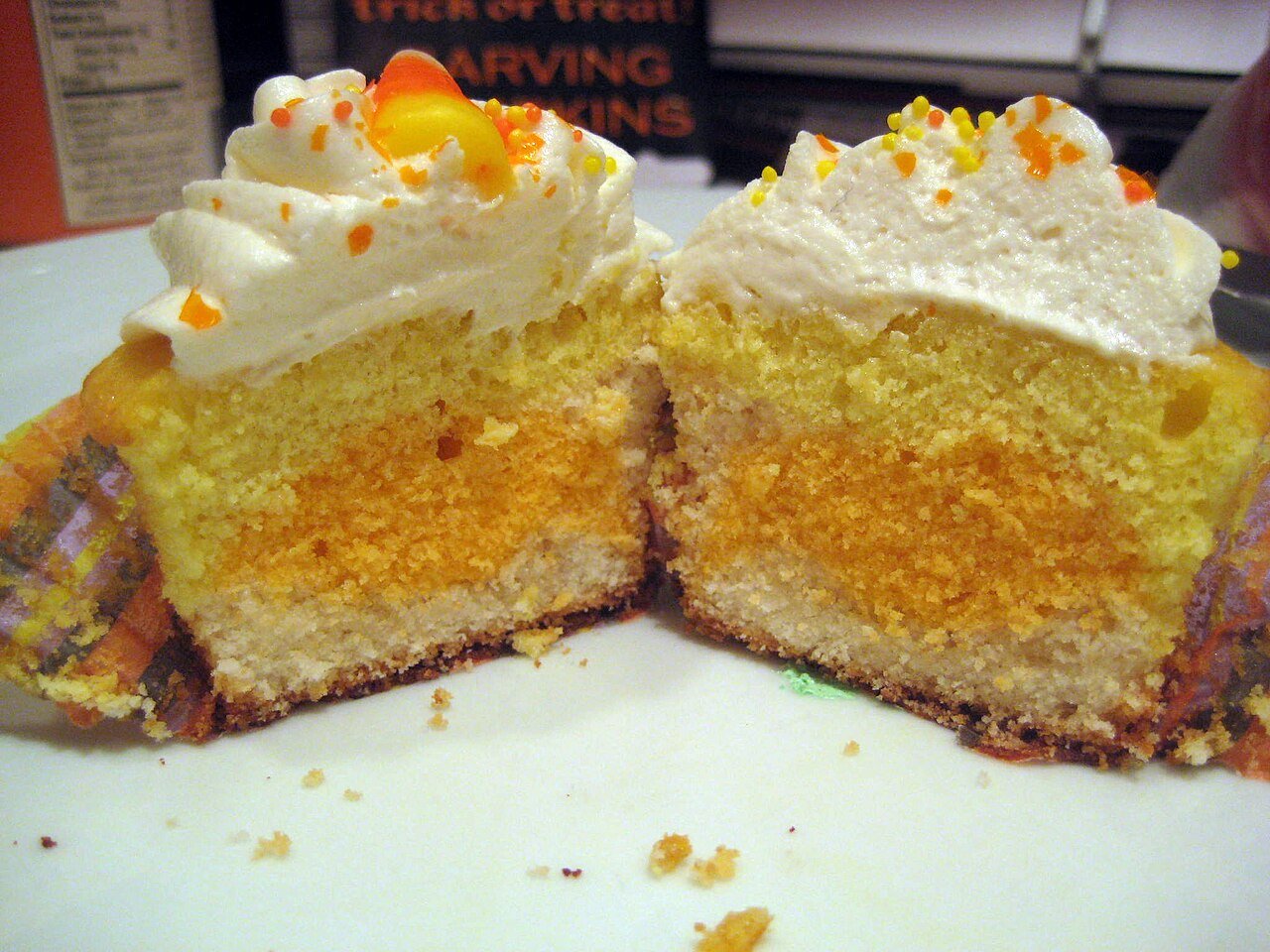
- Design add-ons. Piped flowers, hand painting, sugar decorations or a drip each add measurable minutes. Price them by the time they take at your hourly rate, plus materials.
- Extra layers and height. A third layer adds ingredients, more filling and more finishing time, and it changes the servings count. Rework every line rather than adding a flat fee.
- Rush orders. Fitting a cake into a full week means late nights or turning other work away. Many bakers add a rush fee; set it as a fixed amount or a percentage and state it on your order form.
- Delivery. Charge for the round trip at a per-mile rate you set, plus your time behind the wheel.
- Ingredient swings. Butter and eggs move the most in this recipe. When their prices move, re-run the ingredient table; a 25% jump in butter adds about $1.24 to this cake.
A quick check on your price list
Run the same four steps for each size you sell. A 6-inch and a 10-inch cake are not simple fractions of the 8-inch: ingredients scale with area, but decorating time does not scale as neatly. Pricing each size from its own numbers keeps small cakes from being underpriced.
A note on selling from home
Whether you may sell cakes from a home kitchen, and what your label must show, depends on your state’s cottage food law and its agency. Check your state’s official cottage food program page before you take orders, and see the FDA’s food labeling pages for federal labeling background. Bakeqo prices orders from your own numbers; it does not give legal, tax or food-safety advice.
FAQ: how to price a cake
Is “ingredients times three” a good way to price a cake?
Not for decorated cakes. In the example above, ingredients are $10.01 while labor is $63.00. Tripling ingredients gives about $30, which would not cover the time.
What hourly rate should I charge?
It is your decision. A floor to compare against is the BLS national median for employed bakers, $17.86 an hour in May 2025. Self-employed decorators usually aim higher because they also handle orders, shopping and cleanup.
How many servings are in an 8-inch round cake?
With 1 × 2-inch party slices on a cake about 4 inches tall, about 24. Larger slices mean fewer servings. State your slice size on your price list.
Should I include my oven and electricity?
Yes, through overhead. Work out a monthly overhead total, divide by monthly sales, and apply that percentage to every order.
How often should I update my prices?
Whenever a big ingredient like butter or eggs moves noticeably, and at least when your hourly rate changes. Re-running the ingredient table takes a few minutes.
Put your own numbers in
The formula only works with your real recipe, your receipts and your timed hours. Bakeqo is building a cake pricing calculator and order desk for home bakers that does this arithmetic from your own numbers and keeps your price list in one place. Read how we build our pricing guides, browse more pricing guides, or tell us which cake you want priced next.
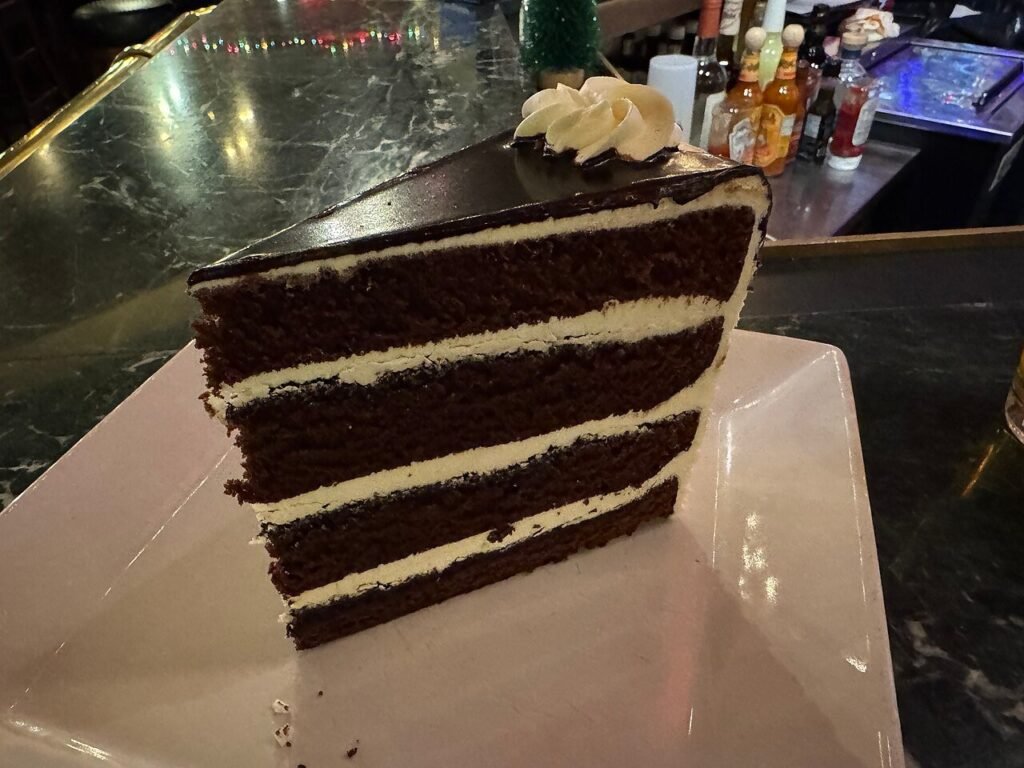
Featured image: layered cake with buttercream and ganache. Photo: Missvain / Wikimedia Commons, CC0. Prices: BLS Average Price Data, US city average, September 2026; wages: BLS OEWS, May 2025. Last checked 29 October 2026.
